Traveling with the Rambam through the Jewish year
As the Jewish year of 5787 approaches, Hillside Memorial Park and Mortuary is honored to share our new annual calendar, created to help our community observe Jewish holidays, weekly
parshiyot, candle lighting times, and other moments of meaning. It arrives, as it does every year, in time to be hung before the High Holidays and to accompany families through the twelve months that follow.
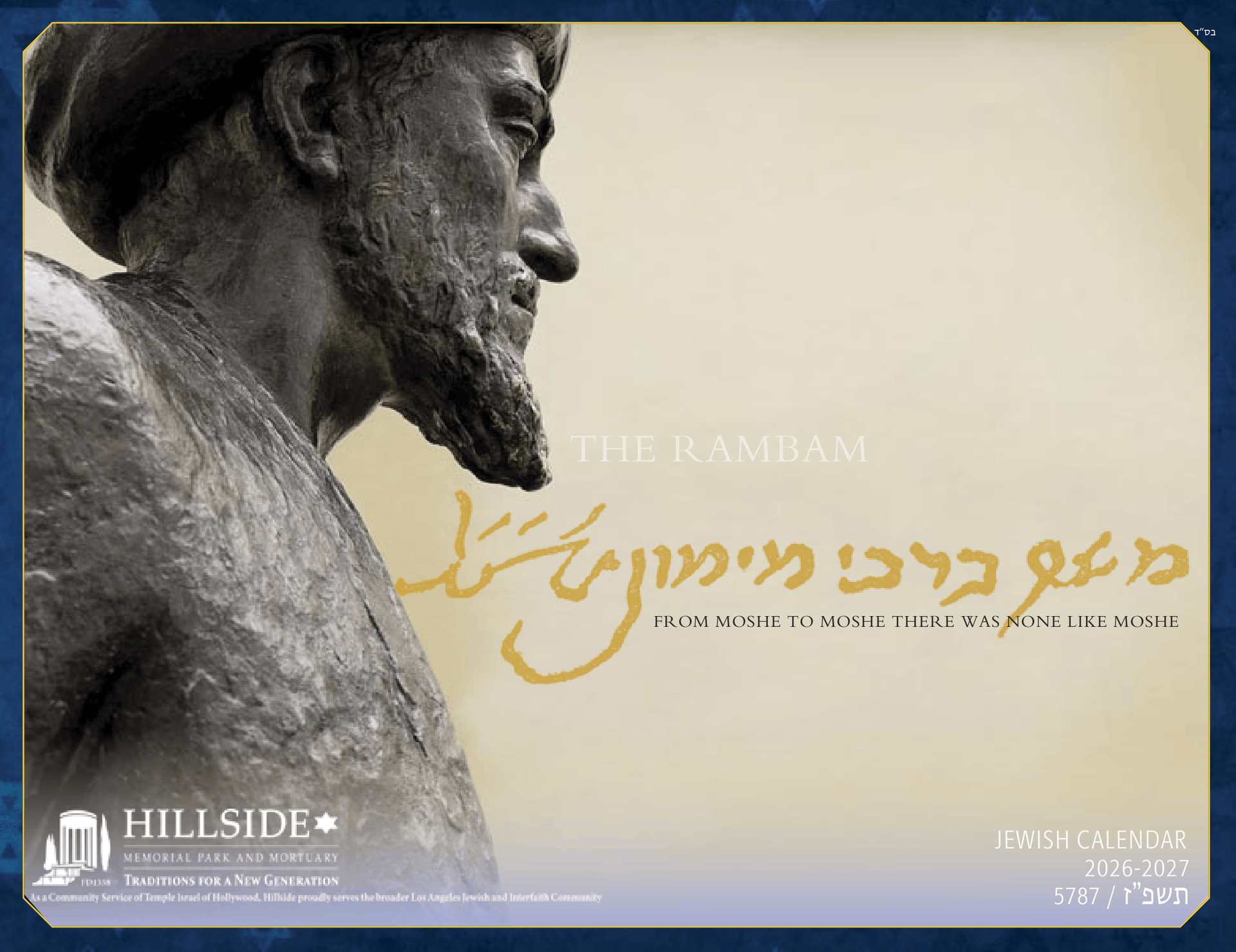
This year’s calendar follows a single life across continents and centuries. Its theme is
Masa Rabbi Moshe ben Maimon, the journey of Rabbi Moses ben Maimon, known to the Jewish world as Maimonides and to generations of students simply as the Rambam. His story is one of displacement and endurance, of a family forced from its home who carried its learning with it, and of a mind whose clarity has guided Jewish life for more than eight hundred years. It is a story about what survives, and about who carries it forward.
The Journey of Moshe ben Maimon
Maimonides was born in Córdoba in 1138, into a family that traced its judges and scholars back eight generations. He might have spent his life there. Instead, when the Almohad conquest of Andalusia demanded conversion to Islam under threat of death or exile, his family abandoned a life that had been generally harmonious and began to move. They traveled north through Christian Spain, then to Fez, where he studied medicine alongside Jewish and Muslim scholars and wrote to fellow Jews urging them to hold fast to their tradition even when they could observe it only in private. From Morocco the family sailed to the Land of Israel, spent several months in Acre, and finally settled around 1168 in Fustat, old Cairo.
The calendar traces that route month by month. Córdoba, Fez, Fustat, and then the works that came out of those years: the
Commentary on the Mishnah, the
Sefer ha-Mitsvot, the
Mishneh Torah, the
Moreh Nevukhim. Alongside them are the roles he filled while writing, as a physician to the Ayyubid court, as
Nagid and head of Egyptian Jewry, and as a correspondent who answered hundreds of questions sent to him from across the Islamic and Mediterranean worlds.
One passage in the calendar comes from Maimonides himself, describing an ordinary day. He rides to the Sultan’s court in Cairo each morning, returns to Fustat in the afternoon to find the porticos full of people waiting, prominent and common alike, and treats patients until nightfall, sometimes deliberating with them while lying down from sheer exhaustion. It is a portrait of a man who never stopped showing up for the people in front of him, and it says as much about him as any of his books.
From Moshe to Moshe
The calendar’s cover carries the phrase inscribed on Maimonides’ own memorial: from Moshe to Moshe there was none like Moshe. It links him directly to the first Moses, of whom the Torah says at its conclusion, “Never again did there arise in Israel a prophet like Moses” (Deuteronomy 34:10). The two men are separated by more than two thousand years, and the tradition places them side by side anyway.
That pairing has a particular resonance at Hillside. Inside the dome of the Al Jolson Memorial, our most recognized landmark, a mosaic of Moses looks down on visitors holding the tablets. Families have walked beneath that image for decades. Choosing the Rambam as this year’s theme lets the calendar begin where our own grounds do, with a name that has carried meaning across generations, and with the understanding that what a person leaves behind is not fixed at the moment of their death. It continues to be shaped by everyone who takes it up.
That is the quiet argument running through all twelve months. Through reflection and storytelling, remembrance becomes legacy. Each life and each name is woven into the larger tapestry of the Jewish people, and we are invited not only to remember, but to carry names, teachings, and wisdom forward with intention from generation to generation.
What the Calendar Holds
A calendar is a practical object, and this one is built to be used. Every date carries both its Gregorian and Hebrew reckoning, so the two ways of counting a year sit side by side on the same page. The weekly
parashah is marked, in Hebrew and in English. Candle lighting times and Shabbat conclusion times are printed for Los Angeles throughout, and the back pages carry a full table of candle lighting times for more than thirty cities across the country, from Atlanta to Seattle, for families with relatives elsewhere.
It is also a planning tool for the year’s most important observances. Holiday dates are listed for both 5787 and 5788, which makes it useful well past next September. Hillside’s own remembrance services are marked on the days they fall: our Kever Avot v’Imahot Remembrance Service on September 20, 2026, our Mother’s Day Remembrance Service on May 9, 2027, and our Father’s Day Remembrance Service on June 20, 2027. Fast days, Rosh Chodesh, Yizkor, and the counting of the Omer are noted as they arrive, and the closing pages include the candle lighting blessings for Shabbat and for holidays in Hebrew, in transliteration, and in English, for anyone who wants the words at hand.
For families observing a
yahrzeit, having the Hebrew date visible on every square of the year makes an anniversary far easier to anticipate rather than remember late. That is often the reason families ask for a second copy, one for the kitchen and one for a parent or a child in another household.
Legacy as a Hillside Value
The Rambam’s journey is a story of a tradition carried through upheaval by people who refused to set it down. That is close to the heart of what we mean by Traditions for a New Generation, and close to what
Tikkun Olam, repairing the world through action, asks of us. Maimonides repaired his world by writing with clarity for people who needed it, by treating patients until he could no longer speak, and by answering the letters that arrived from communities who had no one else to ask.
At Hillside Memorial Park and Mortuary, we see our role in similar terms. We are here for a family at one of the hardest moments of their lives, and we are also here for the decades that follow, in the yahrzeit reminders, the remembrance services, the unveilings, and the small annual act of hanging a new calendar on the wall and finding the dates that matter. A year is a long thing to hold. It helps to have it laid out in front of you.
We are pleased to provide you with a complimentary Jewish calendar for 5787. Rosh Hashanah begins at sundown on Friday, September 11, and we invite you to request yours now so that it arrives in time for the New Year.
Request your complimentary 5787 calendar:
https://www.hillsidememorial.org/calendar-request